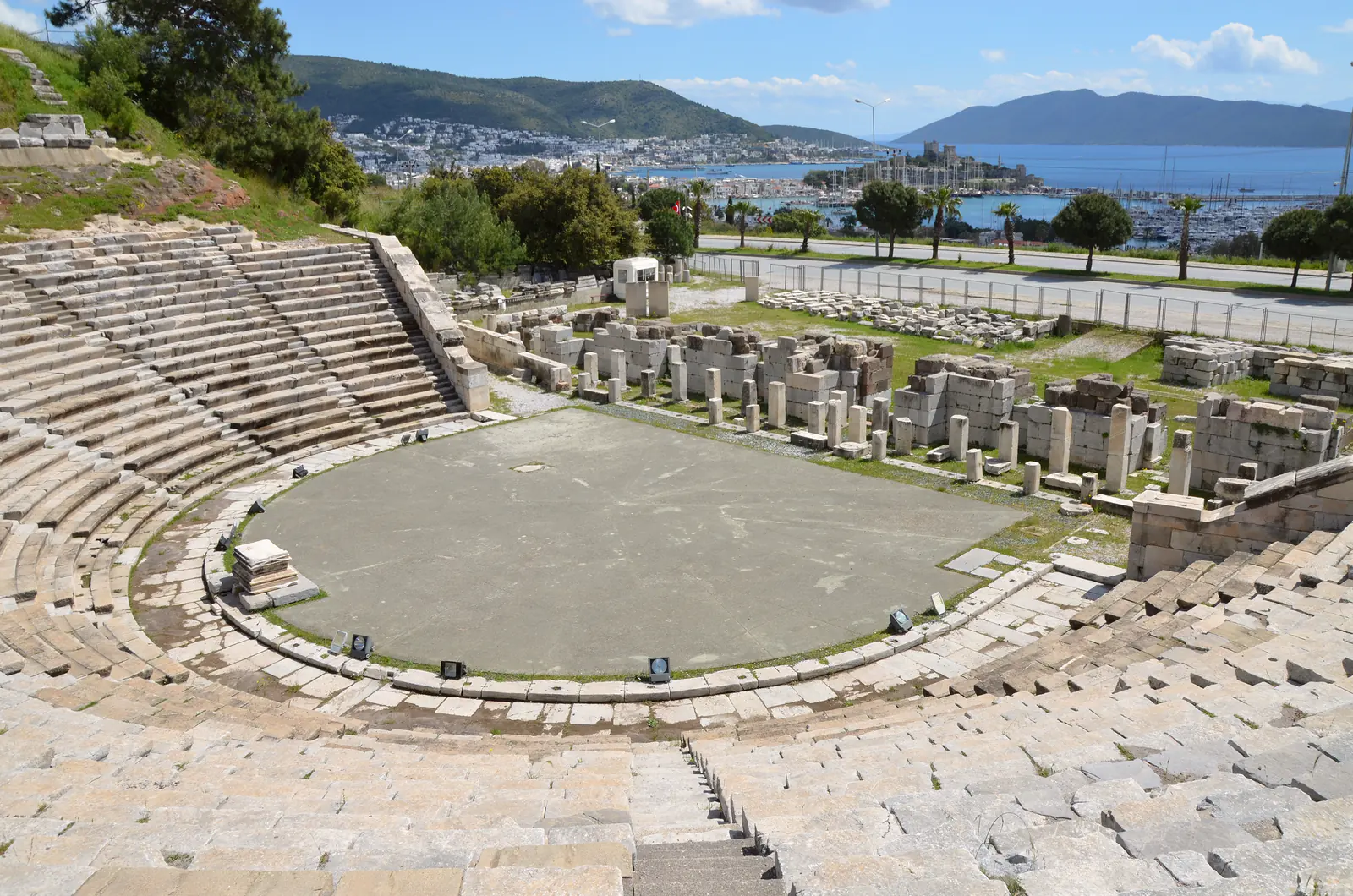
A building taken out of the hill
Ancient Halicarnassus is the city that gave one of the seven wonders its name. The theatre was cut into its north slope in the 4th century BC. The typical Hellenistic approach is plain to see here: the building was not placed on the hill, it was taken out of it.
Part of the seating was cut straight from the bedrock. That was a deliberate choice in both labour and acoustics. The slope gives every spectator a clear view of the stage, and the stone surface carries the sound upward.
Timeline
-
4th century BC
Built. Cut into the north slope of Halicarnassus, Hellenistic period.
-
Roman period
Alterations. The stage building and the seating are reworked for the needs of the time.
-
Later centuries
Use ends and the structure disappears into the hillside.
-
1973
Excavation begins and the site comes back to light.
-
2002
The grounds are laid out and opened for performances. Today’s seating capacity comes from this work.
-
2025
A ministry decision ends concerts in ancient theatres. The season stays empty.
The parts of the building
The parts of an ancient theatre have their own names. Knowing where you are standing changes what you are looking at.
- Cavea
- The seating. Part of it is cut straight from the rock, so the gradient of the hill is the building itself.
- Orchestra
- The semicircle between stage and front row. The place of the chorus in ancient drama, the performance floor today.
- Skene
- The stage building. Where the performers prepared, and what closed the stage from behind. Standing today at foundation level.
- Parodos
- The side passage for audience and chorus. This corridor between the stones is what makes the moment of entering.
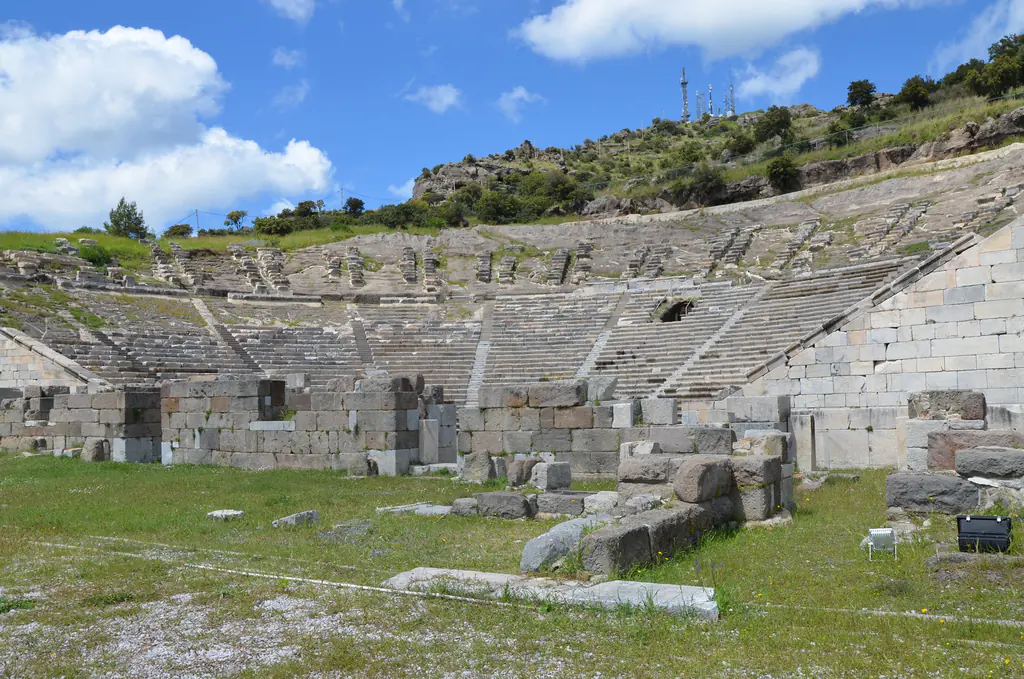
From excavation back to the stage
The building went unused for centuries and disappeared into the hillside. Excavation brought it back to light in 1973. After the 2002 restoration it was opened for events and taken back into use as a summer stage.
Today's roughly 3,100 seats are the result of that work. They are often confused with the estimated 13,000 of antiquity. The two figures describe two different states of the building, not the same one.
Wikipedia, 2002 restoration checked 05.08.2026. There is no official measurement for the ancient capacity, every figure in circulation is an estimate.
If you want to go: entry is free, and the opening hours and route have pages of their own.
This page was checked on 5 August 2026